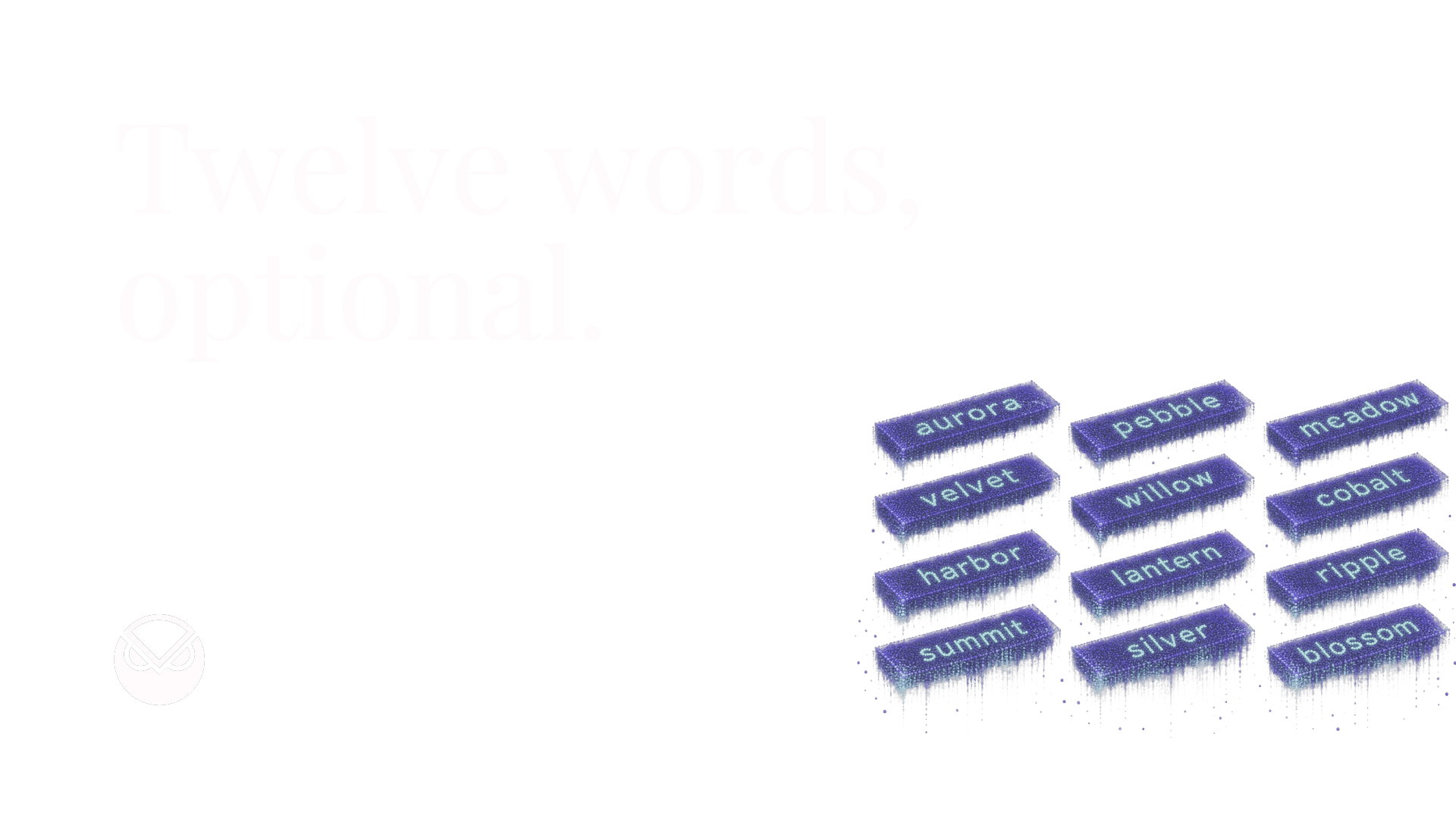
A seed phrase is a list of 12 or 24 words that backs up a crypto wallet, the app that holds your coins. Those words are the master key to everything in it. Lose them and your money is gone. Let someone copy them and they can take it all.
That is the short answer. The longer question is whether you still need a seed phrase today's day and age. You might not. There is now a real alternative, a passkey wallet like Gnosis App, that drops the 12 words completely. A passkey is the same face or fingerprint login your bank app already uses. We built Gnosis App on it, so there is no phrase to write down and nothing for a thief to phish. Below we explain how seed phrases work, how they fail, and what the newer option looks like.
How Does a Seed Phrase Work?
Your wallet creates the seed phrase for you when you set it up. It picks the words at random from a fixed list of 2,048 English words. This follows a shared standard called BIP-39, written in 2013, so most wallets use the same word list and the same method.
The order of the words matters. The same words in a different order open a different wallet. From those words, your wallet builds the secret keys it needs to send and receive coins.
You do not need the math to use it safely. There are more possible 12-word combinations than any computer could ever try. So the words cannot be guessed. The math is not the weak point. The way people store the words is.
Why Are Seed Phrases 12 or 24 Words?
More words mean more security. 12 words is already far beyond what any computer can guess. 24 words adds an extra margin, which some people prefer for large or long-term holdings.
Both lengths are safe. The choice is about how many words you want to write down and store. For most people, a 12-word phrase from a trusted wallet is plenty.
Is a Seed Phrase the Same as a Private Key?
No, and the difference is worth knowing. A private key is a single secret that approves payments from one wallet address. A seed phrase sits one level above that. It can rebuild every key and every address your wallet has ever made.
So a private key backs up one address. A seed phrase backs up the whole wallet. That makes the seed phrase the more useful backup, and the more painful thing to lose.
What Happens If I Lose My Seed Phrase?
Your money becomes locked away for good. There is no reset button, no support line, no “forgot password” link. The company that made the wallet cannot help, because they never held your keys. The blockchain, the shared record that tracks who owns what, cannot help either. It has no way to know you lost your backup.
This is the trade-off of self-custody, which means you hold your own money instead of a bank holding it for you. You get full control. You also carry full responsibility for the backup.
How Do Seed Phrases Get Stolen?
The words themselves are strong. People and fake software around them are the weak spot. The numbers show how often this goes wrong:
Thieves stole $3.4 billion of crypto in 2025, per Chainalysis, a firm that tracks blockchain crime.
76% of those losses came from off-chain attacks: tricking people, stealing logins, and social engineering, not breaking the code.
January 2026 alone saw $311 million taken by phishing, per security firm CertiK. That was 84% of all crypto stolen that month.
Here is how the theft usually happens:
Phishing. A fake wallet or exchange site asks you to “verify” your seed phrase. You type it in. The wallet empties within minutes.
A photo in the cloud. You write the phrase on paper, snap a photo to be safe, and the photo syncs to iCloud or Google Photos. A hacked cloud account then exposes it.
Drainer apps. Bad software asks you to sign a payment or re-enter your phrase, then sweeps the funds.
Theft and pressure. A burglar finds the paper, or a scammer talks a family member into reading out the words.
Lost paper. No thief needed. Misplacing the backup is the most common way people lose access.
The thread through all five: the seed phrase is a single point of failure. Whatever exposes it exposes everything.
Tip: Never type your seed phrase into a website or app that asks you to “verify” it. A real wallet never asks for your full phrase. If something requests it, that is the scam.
How Should I Store My Seed Phrase?
If you use a seed-phrase wallet, store the words on metal, in two places, and never online. Here is the setup most experts recommend in 2026:
Use metal, not paper. Paper burns, tears, and fades. Steel backups (Cryptosteel, Billfodl, Trezor Keep Metal, and Seed12 are common brands) survive fire and water.
Keep two copies in two places. One at home in a safe, one somewhere else, like a bank deposit box or with someone you trust in another city.
Never go digital. No screenshots, no cloud, no password manager, no notes app, no email. The most common consumer loss is a seed phrase photographed and saved to iCloud.
This is real work. It is also why a seed-phrase wallet is a heavy choice for someone holding their first few hundred euros of crypto.
Can I Avoid Using a Seed Phrase?
Yes. Since 2023 there has been a real alternative: the smart wallet. A smart wallet runs as a small program on the blockchain instead of relying on one secret key. This became practical for everyday people with an Ethereum upgrade called ERC-4337, which shipped in 2023. (Ethereum is the largest crypto network.)
Most of these wallets sign in with a passkey instead of a phrase. A passkey is a login tied to your face or fingerprint, stored safely inside your phone, the same kind Apple, Google, and many banks now use. To recover access, you use a second device or trusted contacts, not 12 words.
The big benefit: a passkey is tied to the real website or app, so a fake site cannot trick you into handing it over. That closes the phishing door, the most common way crypto gets stolen. By early 2026, about 62 million of these smart accounts were in use, per Eco’s account abstraction guide. This is not an experiment anymore.
It is not magic, though. If you lose your phone and never set up a backup device or trusted contacts, you can still get locked out. Some experts also note that a passkey was built to log you in, not to guard money, so the wallet’s backup design has to be solid (one well-known critique here). Good smart wallets handle this by separating your login from your money’s recovery.
Key takeaway: A passkey wallet gives you self-custody without a seed phrase. It removes the single most common way people get robbed, though you still need to set up a recovery option.
What Does This Look Like in Gnosis App?
We built Gnosis App on Safe Smart Account, the most-used smart wallet system in crypto. You sign in with a passkey, your face or fingerprint. There is no 12-word phrase to write down or lose. If you change phones, you recover through a second device or trusted contacts.
The app holds stablecoins like EURe (a coin always worth one euro) and others on Gnosis Chain, the network it runs on. For people in the EU, it also comes with a free Visa card you can spend in Berlin, Lisbon, or Madrid, with up to 5% back and no foreign-exchange fees. It includes an IBAN too, the bank account number you use to receive euros. More than 26,000 people use it today.
Gnosis App is not the only passkey wallet. Coinbase Smart Wallet and Ready are solid options too. The point is simpler: if you are picking your first wallet and you want self-custody without the homework of guarding 12 words, a passkey wallet is the easier and safer starting point. Owning your money instead of renting it from a bank is the whole idea, which we wrote more about in In It to Own It in the Age of Apps.
What Is a Recovery Phrase vs a Seed Phrase?
They are the same thing with different names. “Seed phrase” is the original term. Trust Wallet calls it a “Recovery Phrase.” MetaMask, the browser wallet, calls it a “Secret Recovery Phrase.” Ledger, one of the big hardware-wallet brands, also says “Recovery Phrase.”
One related term can confuse people: a “passphrase” or “25th word.” That is a separate extra secret some wallets let you add on top. It is not the seed phrase itself, and you need both to open the wallet.
FAQ
What is a seed phrase? A seed phrase is a list of 12 or 24 words your wallet creates to back itself up. The words are the master key to your crypto. They follow a shared standard called BIP-39, so most wallets use the same method.
How does a seed phrase work? Your wallet picks the words at random from a fixed list of 2,048 words. The order matters. From those words, the wallet builds every secret key it needs to send and receive your coins.
What happens if I lose my seed phrase? Your money is locked away for good. There is no reset, no support line, no recovery. The wallet maker cannot help, because they never held your keys, and the blockchain has no way to restore your backup.
Is a seed phrase the same as a private key? No. A private key approves payments from one address. A seed phrase sits above it and can rebuild every key and address your wallet makes. The seed phrase backs up the whole wallet; a private key backs up one address.
How should I store my seed phrase? Write it on metal, not paper, using a backup like Cryptosteel or Billfodl. Keep two copies in two places, such as a home safe and a bank box. Never store it online, in a photo, or in a notes app.
Can I avoid using a seed phrase? Yes. Passkey wallets built on smart accounts (Gnosis App, Coinbase Smart Wallet, Ready) sign in with your face or fingerprint and recover through a second device or trusted contacts. There is no 12-word phrase.
What is a recovery phrase vs a seed phrase? They are the same thing. “Seed phrase” is the original term; “recovery phrase” is the name Trust Wallet, MetaMask, and Ledger use. All describe the same 12 or 24-word backup for your wallet.
How long is a seed phrase? 12 or 24 words in practice. The BIP-39 standard also allows 15, 18, and 21-word versions, but almost no wallet uses them. For most people a 12-word phrase is the default.
Why are seed phrases 12 or 24 words? More words mean more security. 12 words is already beyond what any computer can guess, and 24 words adds an extra margin for large holdings. Both are safe, so the choice is mostly about how much you want to write down.
What’s Next
If you already have a seed-phrase wallet with real money in it, get a metal backup this week and split it across two places. Thirty minutes of setup beats the odds of losing it to a fire, a thief, or a photo in the cloud.
If you are choosing your first wallet and you live in the EU, try Gnosis App. You get self-custody without a seed phrase, plus a Visa card you can spend like a bank card. If you want to understand storage options first, read our guide on what a cold wallet is, and our honest comparison of non-custodial wallets.
Onwards.


